For Cthulhu cultists bored with traditional busts and idols, the Cthulhu Thinker statue is a fine way to mix it up. Etsy artist Thorssoli has crafted this alternate vision of the Greatest Old One, which doubles as a book end. Statues depicting H.P. Lovecraft's most recognizable creation have exploded in recent years.
From high end Cthinkers to Wacky Cthulhu Bobble Heads for the masses, Lovecraftian decor is no longer out of reach for anyone. Check out the Cthulhu Thinker if you need an unorthodox guardian for your ominous tomes.
Art based on H.P. Lovecraft’s fictional nightmares is very often oriented toward two dimensional works. Great paintings, charcoal sketches, and awesome graphic designs have arisen over the years to pay homage to Cthulhu and other monstrosities, giving Lovecraft’s stories an obscene illustrated life. As a result, we have books like The Art of H.P. Lovecraft’s Cthulhu Mythos, and Centipede Press’ legendary tome, A Lovecraft Retrospective:Artists Inspired by H.P. Lovecraft. While stunning two dimensional products by Lovecraftian professionals is well worth the attention, it causes interesting three dimensional pieces to be overlooked.
HP Lovecraft in stained glass by Spectral Creations
The fledgling stained glass industry is one such underground beast. It’s difficult to know what ever inspired artists to freeze Cthulhu’s image in mystic glass. The occult wisdom of such a move notwithstanding, its success makes Lovecraft the only weird fiction author to date with stained glass made in his image.
A traditional Cthulhu glass design by Chantal's Stained Glass Patterns
Glass designs thus far have been extremely traditional. The saint-like iconography of everyone’s favorite Great Old One brings an eerily realistic edge to this art. Meanwhile, Lovecraft’s profile takes on a sacrosanct position. The cultural memory surrounding stained glass certainly makes these odd works seem like valuable relics.
Unsurprisingly, the more menacing and serene depictions of Cthulhu and his creator in glass are followed by the humorous. Glassworks like Santa Cthulhu as Christmas tree ornaments show the Cutethulhu phenomenon’s unwavering hold over the minds of artists. In fact, the split of seemingly serious to light hearted Lovecraftian stained glass is about 50-50. Humor, then, is as much an impetus as horror for those who choose to bring Lovecraft to this art form.
One day, it’s possible that Lovecraftiana captured in stained glass will grow into a respectable mini-niche. When that happens, it’s only a matter of time until it begins showing up in future volumes celebrating the highly talented and nearly esoteric quality of Lovecraftian art.
Since William Hope Hodgson's strange novel, The House on the Borderland, first appeared, artists have sought to capture the demented, liminal spirit of the hellish house. Here, it's worth collecting a few of these efforts for comparison. Hodgson's otherworldly house was a product of pure imagination, which earned it praise from weird fiction contemporaries like H.P. Lovecraft.
Depictions of the eponymous house veer toward the decrepit profile given in the novel. Recently, illustrator Richard Corben translated Hodgson's work to the visual medium in his House on the Borderland graphic novel. Corben's house follows the book pretty literally, but also takes the liberty of making the house look exceptionally crooked. Corben's artwork zeroes in on an essential feature of illustrating Hodgson: the house, as a reality spanning nightmare, must reflect its warped realm more than the cliff it seems to occupy.
It's the house and its surroundings, after all, where the supernatural events of the novel unfold. Although visual artists have sought to capture far stranger aspects of Hodgson's story than its house, many images hinge on effectively generating the eeriness and surrealism in the house. The house is ultimately the lever for artistic weirdism that's worthy of the novel, and these are just a few images that come close to that level of justice.
-Grim Blogger
The House on the Borderland by William Hope Hodgson in Art
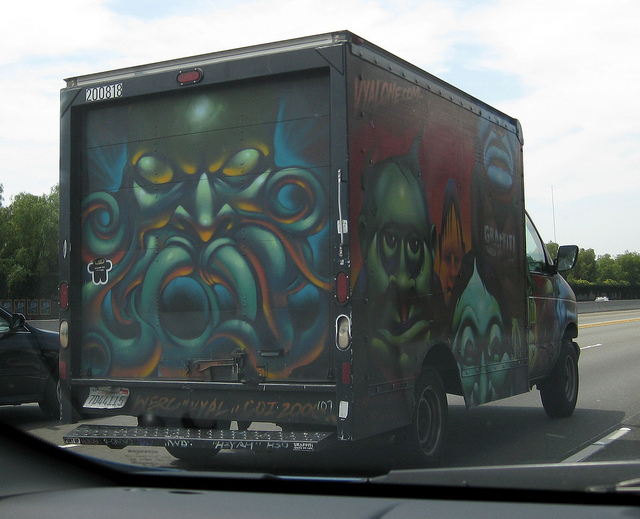
The Great Old Ones have hit the streets, their eldritch silhouettes peeping out from back alleys and railway graveyards. These are several mad visions from Lovecraftian devotees who dared to bring Cthulhu artwork out as public graffiti. That humming sound you hear from the bricks? Just a little inter-dimensional indigestion.
There's no need to strike out with a real Necronomicon when painted visages of the Old Ones are just as good for summoning them. Lovecraftian nightmares know no boundaries, and neither do their disciples in art.
The Lovecraftian graffiti obsession is, like all true movements in terror art, a global phenomena. Here, a French artist has transported Cthulhu by stencil to the bricks of Saint-Etienne, France.
Not surprisingly, public restrooms offer no respite from the Old One's indomitable spirit. As the stars align and madness overtakes the world, don't be surprised if Lovecraft based graffiti art becomes as familiar in stalls as Bible verses and vulgarity.
Not strictly Lovecraft based as such, but worthy of honorable mention. All roads lead to Cthulhu.
Since artists first began putting Cthulhu to canvass, clay, and other mediums, green has been the default color. This likely comes from H.P. Lovecraft's description in "The Call of Cthulhu," where the Providence author wrote:
Everyone listened, and everyone was listening still when It lumbered slobberingly into sight and gropingly squeezed Its gelatinous green immensity through the black doorway into the tainted outside air of that poison city of madness.
So, understandably, delvers into strange visions have sought to faithfully uphold Lovecraft's reptilian color scheme. The average Cthulhu seen in paintings, statues, and Squishable toys is green. Sometimes, though, deviations from the norm are just as interesting, if not more so. Here are a few Cthulhus that shimmer with other colors of the rainbow:
Joshua Hoffine recently unleashed a series of high resolution photos based on H.P. Lovecraft's story, "Pickman's Model." The photo set captures the catastrophic moment when Pickman's artistic horrors are fully unveiled. Hoffine wisely keeps the macabre paintings relatively obscured. This ambiguity lends itself well to the imagination, much like another successful take on "Pickman's Model" not long ago, the film Pickman's Muse. It's also more faithful to the original story, since the best Lovecraftian horrors remain murky in all but the mind.
Hoffine's photographic abominations are painfully realistic, and stunning in their gruesome crispness. One hopes this won't be the last time he visits Lovecraft. Check out the full set and more at Hoffine's blog.
-Grim Blogger
HP Lovecraft's Pickman's Model in Art by Joshua Hoffine
The explosion in popularity for graphic novels means that more folks than ever before are getting introduced to classic masters this way. Weird fiction is no exception, and modern literary horror's founder, Edgar Allan Poe, is seeing a steady uptick in comic adaptations of his stories. The latest is The Tell-Tale Heart and Other Stories illustrated by Gris Grimly, which just went on pre-order.
Grimly is one of visual horror's more unsettled contributors. His often crooked characters bring to mind an underground shadow land, and reflect psychological derangement in their warped bodies. Grimly's work is a fine accompaniment to Poe's fiction, and actually marks the third time the artist has applied his talents to depicting Poe's horrors. He previously illustrated Tales of Death and Dementia and Tales of Mystery and Madness.
Edgar Allan Poe by Gris Grimly
It's always nice to have more of a good thing - and a heaping portion of the Poe-Grimly blend may satisfy macabre hunger pangs for a little while. The third serving with The Tell-Tale Heart and Other Stories is due this August.
-Grim Blogger
New Tell-Tale Heart Graphic Novel Illustrated by Gris Grimly
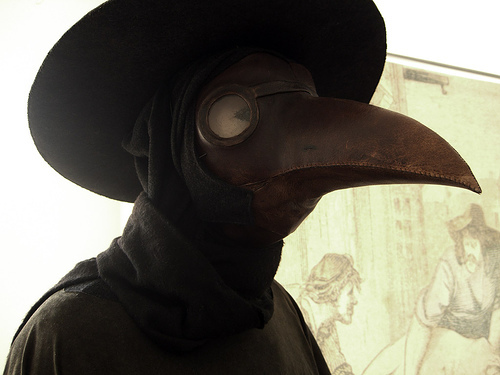
Amid all the awful echoes left by the Middle Ages in Western Civilization, none is stranger than the screams drawn by the Black Plague of the 14th century. The nation culling illness left its eternal mark in art, writings, and collective memory, passed down generation-by-generation, wrapped in distorted shadows. The Plague Doctor remains a particularly eerie reminder of nameless ancestors who suffered premature internments under the pathogenic scythe.
Today, we can only imagine his great beak and glassy eyes leering down at the pale faces of the dying. Unfortunately, this menacing figure was no supernatural force. That would have been an anti-miracle too elegant for this world.
The doctor himself, often a second rate or newly commissioned physician, likely trembled inside his frail costume. Everyone instinctively senses contamination, whether germ theory is officially on the books or not. Then, as now, the doctor's bio-hazard suit induced panic. And Plague Doctors certainly shared the fears of the unguarded, since their herb filled schnozes offered little real protection against the terrible malaise.
Perhaps the Plague Doctor remains scary and strange because it's as much a portent of the future as it is a ghost from a bygone age. In 1915, men released new horrors into the air, requiring a similar face mask for protection. Like virulent plague, airborne chemicals still haunt us as arch-daemons, joined by nuclear radiation and other modern terrors. Fear warps the face as well as the mind in each instance.
The Bubonic Plague is long passed, but its horrors endure (see The Great Mortality: An Intimate History of the Black Death for a full stomach churning history). Western art, including the weird and surreal, continues to carry the legacy of this European reaper. But no aesthetic symbol will ever top the genuine creepiness instilled in the cloaked doctor. He was an ominous horror who once walked the Earth like an animal headed Egyptian deity, heralding doom for millions. And he has walked again since 1350, in greater force than ever before with the teeming variations arisen in the Great Wars. By natural or contrived disaster, he may yet become a familiar sight again, known to all in his final magnificent form.
The Starving of Saqqara is a curious sculpture, possibly pre-dating Egypt, that first surfaced in the 1940s. The sculpture shows two gaunt figures entwined, rendered in a ghostly whiteness. The piece is protected by Concordia University, which has sought a solution to the mystery for decades. This public exhibition is the latest attempt to drum up attention and support for giving the figures greater scrutiny.
While the likeliest origin lays in pre-Dynastic Egypt or outright forgery, more offbeat and chilling suggestions have arisen. Some believe the statue depicts Atlantean refugees. Human sacrifices, famine, and catastrophe in great antiquity draw further speculation as inspirations for the statue. The over-sized heads and gaunt frames are particularly unsettling.
Ancient civilizations coughing up the odd relic have frequently appeared in weird fiction, with horrific results. The Starving of Saqqara is a fear given form, showing what idols from Lovecraft's Atlantis, Lemuria, or other nameless cities might look like. Those moaning faces and unnatural bodies suggest a macabre secret best forgotten by time's merciful ignorance.
The mystery surrounding the statue is reminiscent of the untamed niche centered around Out of Place Artifacts. See Michael A. Cremo's book, Forbidden Archeology, for a full look at the strangeness surrounding humanity's deep past. Whether or not one dismisses Cremo's claims as pseudo-science, they're great exhibits for falling headfirst into a long tradition of weird, Fortean oddities.
The "Metronomicon" photos (with a name clearly inspired by H.P. Lovecraft's Necronomicon) comprise a highly unsettling and underexposed series by Russian artist Alex Andreyev. Moscow's extensive underground network has long encouraged artists' nightmares - most recently sweeping readerships in Russia and beyond through Dmitry Glukhovsky's dark sci-fi novel, Metro 2033. However, Andreyev's work is a bit different.
If someone emptied out the skulls of H.P. Lovecraft, Franz Kafka, and Yevgeny Zamyatin, the deleterious result might look something like these images. Andreyev's over-sized insects and warped locomotives recall much. They remind us that marvels like Moscow's extensive transit system are human entryways into an underworld both mysterious and horrifying.
Many of these pieces represent a loathsome clash: the ultra-modern with the prehistoric. Nothing seems more ancient and out of place than enormous insects in a techno-bureaucratic shrine. Other photographs give a more direct nod to Lovecraft, with tentacles casually plugged into passengers' heads, and tunnel dwelling horrors that may well represent the Providence writer's unfathomable Dholes.
Like the best grim artists, Andreyev also shows us how commonplace the macabre and terrible can be. None of his Moscovites are shocked at the strange happenings around them. Workers in bio-suits get along as best they can with otherworldly monstrosities. His people take an express ride through horror every day, between homes, jobs, and errands. And so do we.
Meanwhile, the shadow circus filling the Metro is as bleak and oppressive as the out-of-place creatures that reside in the darkness. There's a noticeably dystopian aura to the whole business. If the tyrannical Benefactor of Zamyatin's novel, We, had been able to employ otherworldly things that slither and titter, rather than an advanced form of social conditioning, then this Metro might be a glistening slice of that world. Kafka's frightful power rests in the exposure of the surreal and terrible all around us, and he, too, used Cyclopean insects to make his point in tales like "The Metamorphosis" (don't hesitate to pick up Franz Kafka: The Complete Stories immediately, if this tale is unfamiliar).
When you really get down to it, Metronomicon is an appropriate name for this exhibit. Alex Andreyev's magic is his ability to show us other worlds hidden from blind eyes, much like the feared Necronomicon. While the visual, rather than the literary, is his chosen medium, consider him a kindred spirit with Kafka, Zamyatin, and Lovecraft. All have expressed, in one way or another, the unquenchable black tyranny that pervades this cosmos.
Vladimir Pajevic is an elusive artist living in Italy. He's little known in the United States, and probably less so among horror fans. But there's reason he should be. Pajevic's obsessively recurring landscapes, which often show lonely, vegetation stifled gateways, share an inexplicable spirit with the surreal and the strange. His scenes seem so thoroughly isolated and mysterious, in fact, that they provoke serious meditations and unlikely chills.
The real frightful power of Pajevic's art centers in its thick mystery. The artist lends us only scenes of gateways that could go anywhere. They look like the forgotten sentinels of some buried civilization, and what they house within their black tunnels and murky depths is anyone's guess. Unlike overt horror art, Pajevic's landscapes are filled with lush greenery and pleasant skies. His structures show none of the crumbling ramparts or twisted towers of Gothic castles.
Yet, anyone with an appreciation for darkness who stares into Pajevic's paintings (and I mean, really gazes into them) will see that something is just...off. Few pieces exhibited online show any life except for those damnable plants, growths which seem more like relentless, foreign invaders than signs of vibrant life. Moreover, several pictures show abandoned toys outside the gates to nowhere. The absence of their owners as well as the overwhelming presence of those vines and leaves conveys a severe melancholy atmosphere, obscured at first glance by the gentle scenery.
Like the best strange magicians in other mediums, Vladimir Pajevic bottles his sinister atmosphere in containers tilting toward the bright and mundane. Personally, I can't look at his paintings without feeling the subtle eeriness found in Robert Aickman's fiction, or in David Lynch's bewildering dread on film. In some ways, Pajevic's suggestive bleakness is stronger than, say, Aickman's The Wine Dark Sea, or Lynch's Inland Empire. That's because it's so still, so deceptive, and staring you point blank in the face. No one can know where those gateways lead, but it's difficult to imagine it's anywhere good. Worse, the gateways themselves are beginning to disappear in many paintings - as if whatever dwells in those hidden gardens behind the walls won't be content to stay there forever.
With visual hallucinations as quietly provocative and unsettling as these, expect Vladimir Pajevic to become a more familiar name one day. Regrettably, this may take some time, however, as the artist is nearly as shadowy and uncertain as his products. Italian and other European readers may have better fortune finding information about Mr. Pajevic, but those of us in the English speaking world can only wait, wonder, and quiver at the unsaid mysteries in these occult paintings.
You can thank artist Ben Tripp for this unsettlingly realistic piece. "Braised Cthulhu" uses a unique method to achieve its grim effects: macabre artwork is placed over a real photo of a colorful plate. The result is a dish best served in Innsmouth's finest establishment. While the true horror will always be confined to anthologies like Shadows Over Innsmouth, Tripp's contribution to Lovecraftian art exudes its reality blurring magic, making one think twice about what might have dwelt in the depths with their next seafood dish.
Ambrose Bierce's often sardonic and melancholy strange fiction has inspired artwork that's nearly as disturbing as the texts it sprang from. Bierce's horrors are frequently manifestations of a tormented psyche - imagined or real - and hold no punches in their effect on his hapless characters. It is a feverish and almost unclassifiable brand of exotic cruelty among his ghosts, wartime victims, and other entities that makes his work truly scary. The same must be said for Biercian artwork.
The cover image on Ghost and Horror Stories of Ambrose Bierce clearly expresses an uncertain nightmare. The twisted, almost dream distorted face leering at the reader also brings to mind M.R. James' infamous ghosts formed from clothing and sheets.
"The Damned Thing" by IrishWastrel (Deviantart.com)
"One Summer Night" by Grelin Machin
The visual frights engendered by Bierce's fiction capture every story at some level, but, of course, there are particulars. "The Damned Thing," arguably his most renowned weird horror tale, has challenged many artists to depict the invisible creature responsible for this story's eerie troubles. Showing an invisible demon isn't an easy task by any means, and following Bierce's description with full faith almost leaves too much to the imagination. So, we get images like the one above, where the accursed monster is shown as a menacing blur, which heightens the strangeness, in some respects. Stories contain "One Summer Night" more tangible demons, but are no less horrific in their dark satire, expressed through themes about burial "alive" and grave robbery. The largest (and best) collection of artistic attempts to put Bierce's words to pictures is in Graphic Classics: Ambrose Bierce.
Finally, Ambrose Bierce himself has generated many unusual portraits as a shadowy, borderline malevolent figure in his own right. Beneath the obscuring mustache and the furrowed brow, his constant state of reflection on the unpleasant side of this world is clear. If there's one conclusion one reaches from reading many Bierce tales, it's that the author was incapable of ignoring his dark obsessions. Whatever their origin, they used his eyes, his mind, to ogle the world and translate its odd tragedies in a way as bleakly surreal as the smeared face on Ghost and Horror Stories of Ambrose Bierce. Luckily, this isn't lost on artists, who have re-imagined his brooding nature in ways as diverse as they are authentic.
Although R'lyeh gets most of the attention given to sunken city's in H.P. Lovecraft's universe, Y'ha-nthlei has also inspired modest fascination in art, film, and post-Lovecraft fiction. It was first described in "The Shadow Over Innsmouth," and hinted at in associated stories - a majestic hub for the Deep Ones, not far from tainted Innsmouth. As repugnant as Lovecraft makes his underwater denizens, he doesn't hesitate to give Y'ha-nthlei a brilliantly divided aura of frightful awe, drawn from his own rich appreciation for vanished civilizations in antiquity. "Many-columned" Y'ha-nthlei is said to have "...a phosphorescent palace of many terraces, with gardens of strange leprous corals and grotesque brachiate efflorescences."
"Devil Reef" by Alan M. Clark
In many ways, Y'ha-nthlei's position as an alien and degenerate Atlantis makes up for the truly weird charm it lacks, which Lovecraft applies to other places, such as R'lyeh and its irrational geometry. Discussing Y'ha-nthlei can only begin with a look at its gateway (or, at least, its chief outpost and point for human contact), the Devil Reef. This monstrous trading post, where Captain Marsh first made deals with the Deep Ones in the 19th century, should be considered an outgrowth of Y'ha-nthlei, whether it's truly connected by geography or not. Artists like Alan M. Clark have seized on Devil Reef's importance to the whole Deep One Mythos, re-created haunting scenes from Lovecraftian history on canvass.
"Y'ha-nthlei" by ZS3 (Deviantart)
Getting down to the undersea metropolis, one realizes that artists have unchained their imaginations and techniques, letting them loose in pursuit of a sincere Lovecraftian aesthetic. The intentional ambiguity regarding the city means some will see only ruins, while others imagine magnificent temples under the waves. The imposing palaces mentioned by Lovecraft are rendered in full color, or with haunting realism thanks to artful modifications to real cathedrals.
"The Deep Ones" by Chiselgrind (Deviantart)
Still art isn't the only medium to provide immortality to Y'ha-nthlei. Stuart Gordon's film, Dagon, which is a modernized re-telling of "The Shadow Over Innsmouth" set in Spain, shows us a dark stand in for Y'ha-nthlei as the movie's narrator, like Lovecraft's, gives himself over to the madness of his non-human heritage. The city, and others like it spread across the globe, have been unveiled in fiction as well. Stephen Jones' Shadows Over Innsmouth anthology collects the most sophisticated expansions to the Deep Ones and their civilization, written by talents like Ramsey Campbell, D.F. Lewis, Neil Gaiman, and many more. Not surprisingly, the Deep Ones and their underwater base have fortified their place in Lovecraftian humor as well. No where can this be seen better than in Kenneth Hite's children's book, Where the Deep Ones Are.
Despite a cult following in art and fiction, Y'ha-nthlei, barring some new treatment that goes viral among fans, will likely remain in the shadows for the near future. This, however, won't last. It's only a matter of time before many others realize the fantastic potential of further illuminating the Deep Ones' civilization, including the urban seat of their batrachian reach in the Americas.
Artist and graphic designer Craig Simmons shared this sensational take on the prehistory of the Cthulhu Mythos on Reddit earlier this week. Cthulhusaurus Rex is the product of a fertile imagination, and perhaps inconceivable genetic experiments by the Great Old Ones.
When you really think about it, exploring Cthulhu and the dinosaurs has rarely been touched. Yet, H.P. Lovecraft leaves little doubt about Cthulhu's influence in ancient history. The same can be said for other space faring races, such as the Great Race of Yith. "The Shadow Out of Time"(so recently put to excellent radio drama by Dark Adventure Radio) makes it clear that malevolent cosmic forces were on earth before the dinosaurs spawned their own prime terrors such as the T-Rex. In recent times, only Neil Gaiman's story, "I, Cthulhu," gives a nod to Cthulhu in the age of reptiles. Lovecraft's principle monstrosity humorously speaks about his life, including his responsibility for destroying the dinosaurs.
If this Cthulhusaurus is any indication, it seems not all the dinosaurs were consumed in a ravenous tirade.
Kris Kuksi, the stunningly talented maker of intricate, grotesque sculptures released his first art book last month. Divination and Delusion weighs in at nearly 150 pages, each collecting the artist's beautifully rendered nightmares and detailing his inspiration. As I previously discussed here, Kuksi remains a highly original craftsman with an aptitude for sharing what torments him like no one else can. His sculptures are windows into a secretive world filled with awe, horror, and all manner of nasty little secrets: a devastating miniaturization of our own dark environments.
Death lurks around every corner in these works, planting its conquering standard on every soaring temple and industrial theme park created by Kuksi. Like hideous dioramas mapping long bygone civilizations (or those still to come?), his sculptures are charts of interstitial places we rarely see connected. The industrial-spiritual, for instance, frequently haunts Kuksi's cityscapes. If Hieronymous Bosch had lived several centuries later, complete with the same hellish visions, and traveled to India or Tibet to observe oriental mysteries, then he might have painted something akin to these works.
Kuksi, however, one ups even this alternate history version of Bosch. His meticulously carved and positioned terrors are born in three life stopping dimensions. Not two, although the book shows specimens of Kuksi delving in this lesser dimension as well. Leering skulls with mechanized augments peering down upon factory Popes give the impression they may look at you next. Emotionally charged re-imaginations of real and ahistoric emperors, from Rome to Napoleonic Europe, burst from their musty sepulchers, arriving in more post-industrial rococo splendor than their lost worshipers gave them.
Divination and Delusion is sure to be a powerful flare shot from Kuksi's elegant and numinous underworld. It's a product of his past successes, but more importantly, a new engine certain to drive these frightful and thought provoking visions into new territory. So, go ahead, impale your eyeballs on Kris Kuksi's ornate, reaper tipped lances. You just may begin to see what he has seen.
-Grim Blogger
Divination and Delusion by Kris Kuksi Now Available
Cthulhu's extraterrestrial taint has long been mingled into Christianity, Islam, and other Western religious traditions by gifted artists and writers. But what about the East? Remarkably, there are a few spectacular artistic examples of what happens when Lovecraft's worlds collide with Eastern spirituality. The most common form, not surprisingly, parodies the Buddha statues commonly found in temples, restaurants, and kitsch stores. This seems a natural manifestation of Cthulhu, who is no stranger to appearing in horrific idols. Santani's Cthulhu (upper right) is a highly alien depiction, while the stone statue displays a more tradition look.
Buddhism isn't the only religion to host Cthulhu's nightmarish visage. In another unsettling example, we see Cthulhu as a stand in for Vishnu, the Hindu god often associated with destruction. There's no evidence the paned sculpture is explicitly Eastern or religious, but I decided to include it because it's reminiscent of the wildly detailed carvings seen inside temples in Southeastern Asia.
Blissfully, fiction is far more rife than art with Lovecraftian references and monstrosities colliding with Eastern mysticism. Check out Asamatsu Ken's exemplary series of Lovecraftian tales translated from Japanese, Lairs of the Hidden Gods, beginning with Night Voices, Night Journeys. There's more Cthulhuvian terror mixed with Eastern spiritual traditions than you dare imagine.